
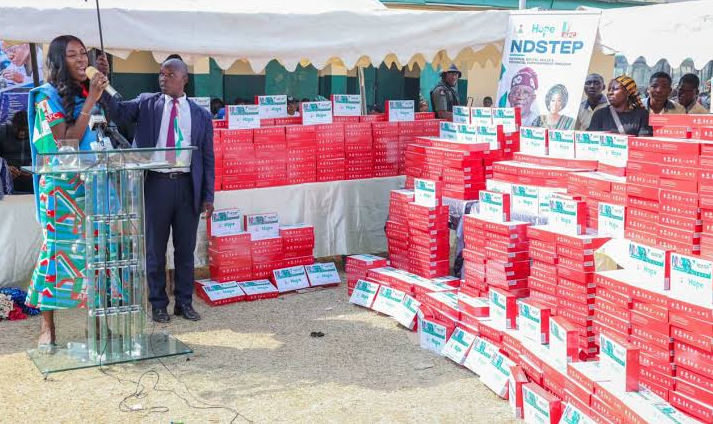
- Offline-first strategy: Nigeria’s NDSTEP rollout distributed 1,000 locally assembled Zinox tablets preloaded with educational software to bypass prohibitive mobile data costs and connectivity dead zones.
- Ambitious national scaling: The government aims to expand the initiative from a single Abuja school to one million secondary students across all 36 states, facing steep logistics, electricity, and teacher training hurdles.
- Maintenance vulnerabilities: While the curriculum includes basic device repair training, long-term success hinges on establishing dedicated institutional spare-parts budgets rather than relying solely on hardware handouts.
On Thursday, November 26, 2026, Nigeria's Federal Government handed out 1,000 digital learning devices to senior secondary students at [Government Secondary School, Ushafa](https://www.google.com/search?kgmid=/g/11f2v4gf4s), in Abuja's Bwari Area Council. Led by Dr Abiola Arogundade, Senior Special Assistant to the President on Technical, Vocational and Entrepreneurship Education, the rollout launched the National Digital Skills and Technical Empowerment Programme (NDSTEP). Officials say the programme aims to reach one million students across all 36 states.
Hardware handouts rarely fail on launch day. The cameras click, dignitaries deliver speeches, and students celebrate new screens. Real failure happens six months later in dusty staff rooms when chargers go missing, screens crack, and local technicians are nowhere to be found. West African ministries have spent years chasing hardware-first education policies without solving recurring maintenance budgets.
Offline Software Bets Against Connectivity Reality
The Ushafa rollout relies on locally assembled Zinox Power Tabs preloaded with a digital learning manual and technical training modules. According to the Office of the Senior Special Assistant on Technical, Vocational and Entrepreneurship Education, the tablets operate entirely without internet connectivity. Preinstalled modules cover artificial intelligence, coding, internet safety, solar energy, basic hardware repairs, trading, and entrepreneurship, alongside practical exercises and assessments.
Choosing offline-first software is the smartest engineering decision in this rollout. Across public schools in Nigeria and neighboring Ghana, mobile data costs remain prohibitive for daily classroom video or cloud software. By packaging lessons locally onto Zinox devices, NDSTEP bypasses telecom dead zones and recurring bandwidth bills. Yet static content carries a shelf life. Artificial intelligence tools and coding frameworks change fast, meaning preloaded curricula risk teaching outdated syntax unless the Presidency establishes clear physical or local-server update cycles.
Ambitious Scale Meets Classroom Economics
During the Abuja ceremony, Dr Arogundade set a target of distributing devices to one million Nigerian students nationwide, expressing optimism for measurable gains in student digital proficiency within six months. The presidency also extended device access to teachers at the school, while Ushafa Head Boy Abdulrahman Usman noted the tablets would support technical learning. Elsewhere in Abuja during the same week, the Federal Ministry of Education outlined a broader National Education Technology Strategy seeking to merge 26 separate government initiatives into one unified system.
Moving from 1,000 tablets in one Federal Capital Territory school to one million units across 36 states requires massive capital and supply-chain discipline. A single batch in Bwari Area Council benefits from proximity to federal oversight in Abuja. Scaling into rural classrooms in Zamfara, Bayelsa, or Cross River introduces steep logistics costs, irregular grid electricity for charging, and uneven teacher readiness. Handing a tablet to a teacher does not automatically redesign a lesson plan built around chalkboards and rote memorization.
How do Nigeria's new NDSTEP tablets work without internet access?
The Zinox Power Tabs distributed under NDSTEP come preloaded with offline applications, interactive assessments, and a digital manual covering coding, AI, solar energy, and basic repairs. Because lessons live directly on internal storage, students in Abuja and across Nigeria can study without paying for mobile data or relying on unstable school Wi-Fi.
Maintenance Culture Will Decide Success
At the Ushafa presentation, officials highlighted that the preloaded curriculum includes modules on solar energy and basic device repairs. Dr Arogundade urged beneficiaries to treat the tablets as practical tools for skill acquisition rather than entertainment gadgets, emphasizing discipline and responsible ownership before graduation.
Teaching basic hardware repair inside the tablet itself hints at an honest reckoning with local infrastructure. If students learn how to diagnose battery faults or maintain small solar setups, schools might build internal repair capacity instead of abandoning broken units. However, public school administrators in Lagos, Abuja, and Kumasi know that student enthusiasm alone cannot replace institutional spare-parts budgets. Without dedicated school-level repair funds and strict inventory tracking, a one-million-device target risks becoming an expensive warehouse problem rather than a classroom revolution.
In the same week as the November 26, 2026 Ushafa distribution, the Federal Ministry of Education confirmed its new National Education Technology Strategy will attempt to consolidate 26 fragmented federal digital initiatives under one coordinated framework.