
Washington, D.C. — August 26, 2026 — NASA engineers and technical teams completed encapsulation of the Nancy Grace Roman Space Telescope on Wednesday, August 26, 2026, clearing the advanced observatory for final launch preparations ahead of a targeted August 30 liftoff. The spacecraft was secured inside the protective payload fairing of a SpaceX Falcon Heavy rocket at Launch Complex 39A at the Kennedy Space Center in Florida.
The mission represents a major milestone in space observation, designed to investigate cosmic expansion, map dark matter, search for dark energy, and discover thousands of new exoplanets beyond our solar system. The spacecraft will ultimately travel toward the second Sun-Earth Lagrange point (L2), located roughly 1.5 million kilometers away from Earth, where gravitational stability allows continuous deep-space observation.
SpaceX Falcon Heavy Integration and Launch Architecture
The upcoming flight utilizes a SpaceX Falcon Heavy launch vehicle, which employs three connected booster cores to generate the immense thrust required to lift heavy payloads into deep trajectories. Technicians completed the payload integration inside the Payload Hazardous Servicing Facility, ensuring the delicate optics and instruments remain shielded from atmospheric friction during ascent.
Once the rocket clears the densest layers of the atmosphere, the two protective fairing halves will separate and fall back toward Earth, where SpaceX recovery teams plan to retrieve them. The encapsulated observatory will then separate from the upper stage to begin its multi-week transit toward the L2 Lagrange point.
Scientific Objectives: Exoplanets and Cosmic Expansion
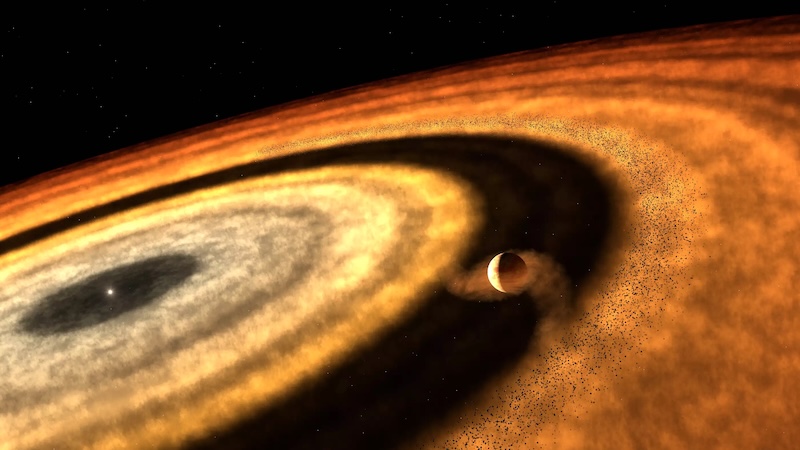
Equipped with a wide-field instrument providing a view 100 times larger than the Hubble Space Telescope's infrared instrument, the Roman observatory will survey vast regions of the Milky Way. Astronomers expect the mission to uncover thousands of previously undetected planets, helping researchers determine how planetary systems form and evolve across diverse galactic environments.
Beyond extrasolar worlds, the telescope will gather precise data on distant galaxies to map the distribution of dark matter and measure the accelerating expansion rate driven by dark energy. These observations will provide critical empirical constraints for modern cosmological models regarding the ultimate fate of the universe.
Mission Timeline and Ground Operations
With encapsulation complete, transport procedures to move the Falcon Heavy assembly from the integration hangar to the launch pad are scheduled for the coming 48 hours. Final systems checks and fueling protocols will follow ahead of the primary launch window opening on Sunday, August 30, 2026.
NASA project managers confirmed that backup launch windows remain available through early September should unfavorable weather conditions develop at the Florida launch site during the initial countdown sequence.
What is the primary scientific mission of NASA's Roman Space Telescope?
The primary scientific mission of NASA's Roman Space Telescope is to investigate cosmic expansion, map the distribution of dark matter and dark energy, and discover thousands of exoplanets orbiting distant stars using a wide-field infrared instrument.
The spacecraft is scheduled to launch aboard a SpaceX Falcon Heavy rocket from Kennedy Space Center on August 30, 2026.