
- Inverted pricing structures: West African MTN subscribers face flawed rating engines where purchasing higher-tier data bundles yields less total volume than repeatedly buying smaller, lower-cost packages.
- Operational service failures: Customers experience premature data throttling on timed plans and artificial reloading lags that inadvertently drain account airtime at exorbitant pay-as-you-go rates.
- Regulatory oversight gaps: While MTN blames operational costs and smartphone background data usage, national watchdogs in Ghana and Nigeria lag behind European standards by failing to conduct real-time price-matching audits.
ACCRA, Ghana — Mobile data subscribers across West Africa are experiencing severe wallet drain due to distorted rating engines on the region's largest network. Consumers in both Ghana and Nigeria have launched widespread public complaints regarding rapid bundle depletion. These complaints reveal a structural pricing defect where buying in bulk yields less data per unit of currency. The issue triggers severe economic friction as inflation forces households to cut daily expenses.
MTN controls the largest share of mobile subscriptions in West Africa. Yet, its pricing architectures penalize subscribers who choose mid-tier volumes rather than smaller flexi-bundles. Independent auditing of the network's current USSD sales menus confirms that price calculations do not follow linear economic math. The resulting financial deficit hurts lower-income users who buy data bundles blindly without verifying the underlying math.

Inverted USSD Bundle Mathematics In West African Markets
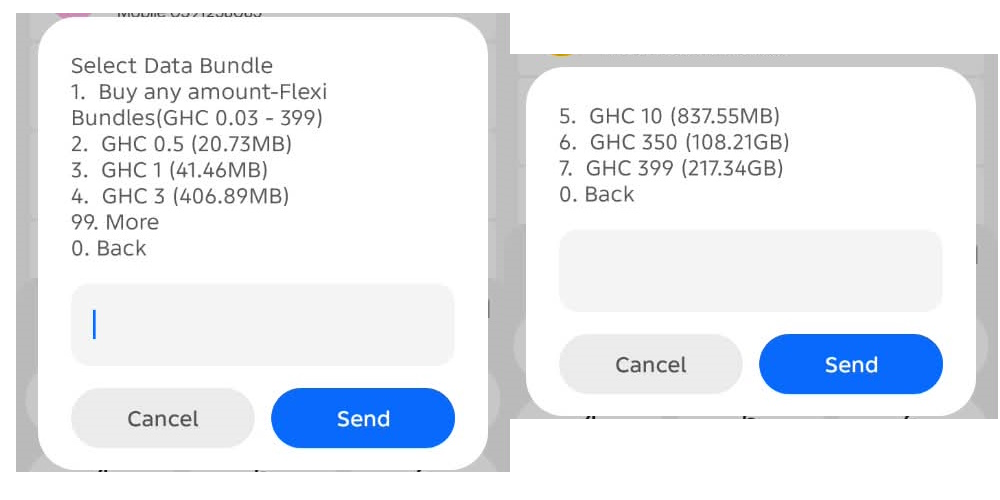
Figure 1: Active MTN data bundle USSD menus showing disproportionate pricing structures in Accra, Ghana.
| Purchase Option | Total Cost | Data Received | Value Deficit |
|---|---|---|---|
| Option 4 (Purchased 3x) | GHC 9 | 1,220.67 MB | Baseline Yield |
| Option 5 (Single Tier) | GHC 10 | 837.55 MB | Bulk Penalty |
| The Financial Deficit | -GHC 1 | -383.12 MB | Net User Loss |
A deep examination of the active MTN menu options in Accra reveals stark numerical contradictions. Option 4 sells 406.89 megabytes of data for 3 Ghanaian Cedis. Meanwhile, Option 5 charges 10 Ghanaian Cedis for 837.55 megabytes. If a customer buys Option 4 three consecutive times, they spend 9 Ghanaian Cedis and secure a total volume of 1,220.67 megabytes. Moving up to the higher tier costs more cash but strips away user data.
Selecting Option 5 causes an immediate loss of 383.12 megabytes while charging a 1 Cedi premium. This structural inversion means spending more money yields less product. The exact same pattern occurs when users enter custom data values into the rating system. Telecom engineers admit that multi-tier pricing grids often run on separate promotional layers. However, the system fails to correct the financial penalty imposed on consumers who assume higher fees mean better bulk bargains.
Truncated Tariffs And Systemic Top-Up Lags
The operational drain spreads far beyond baseline menu packages into daily service delivery mechanics. Time-bound early morning bundles like the popular Kokoroko plan are marketed to run strictly from 5:00 AM until 8:00 AM. In practice, data links frequently drop or experience heavy throttling by 7:30 AM. Cutting off access 30 minutes early violates consumer agreements and constitutes false advertising to subscribers who rely on early web windows.
Furthermore, data reloads are rarely instantaneous when an account balance hits zero. Subscribers track an artificial lag of up to 15 minutes before a paid top-up reflects on their active balance. During this dead-zone window, background phone operations default to direct airtime browsing. The network silently docks airtime at exorbitant pay-as-you-go flat rates before the bundle lands. Telecom executives deny intentional sabotage, blaming delayed network handshakes between banking servers and base stations.
Corporate Defense Versus European Regulatory Blueprint
MTN corporate leadership in Lagos and Accra firmly rejects allegations of billing fraud or artificial data theft. Corporate executives argue that modern smartphone operating systems consume high volumes of background data via automatic cloud backups and social media video loops. Telcos also point to high operational costs, specifically diesel expenses for powering remote transceiver stations, to justify high baseline tariffs.
This ongoing friction exposes a massive gap between West African regulators and international standards. In the United Kingdom, the communication regulator Ofcom strictly blocks telecom providers from exploiting asymmetric consumer information. Ofcom bans inflation-linked contract hikes and mandates that all price rises be stated upfront in absolute currency. It also enforces One Touch Switch rules to allow consumers to escape to cheaper SIM-only deals within 24 hours.
What caused the inverted data pricing tiers on West African telecom networks?
The inverted pricing stems from uncoordinated pricing layers within legacy rating engines. Telecom operators stack temporary promotional bundles alongside standard baseline tariffs without auditing the overlapping per-megabyte costs. This creates mathematical dead-zones where single higher-tier packages provide less total data volume than purchasing multiple low-cost flexi-bundles sequentially.
National watchdogs like the Nigerian Communications Commission and Ghana's National Communications Authority remain focused on spectrum auctions and market dominance. They do not run real-time price-matching audits on retail packages. Consequently, operators continue to gather massive revenue from uncalculated consumer purchases. The current monitoring timeline requires West African regulators to review baseline telecom cost models before the next quarterly review cycle begins on December 31, 2026.