- 15-year blueprint launched: Ghana introduced its 2026-2040 Foundational Learning Agenda to improve literacy and numeracy for roughly 13 million children aged four to eight.
- Curriculum and language shift: The policy prioritizes local languages for early instruction, introduces basic tech skills like coding and AI, and utilizes data labs to target under-resourced schools.
- Long-term execution focus: Backed by international partners and baseline metrics, officials emphasize the need for a full decade of consistent measurement to overcome political cycles and ensure workforce readiness.
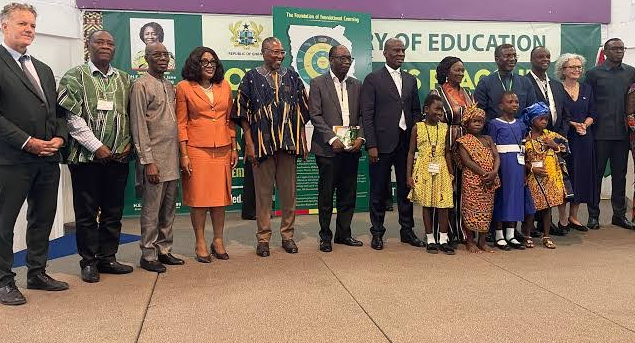
Ghana formally launched its 2026-2040 Foundational Learning Agenda at the British Council in Accra on November 11, 2026. Vice President Professor Jane Naana Opoku-Agyemang and Minister for Education Haruna Iddrisu led the unveiling alongside development partners and classroom educators. The 15-year blueprint targets roughly 13 million children aged four to eight across public and low-fee private schools.
Data drove the urgency behind the rollout. Results from the 2024 National Standardised Test, which assessed nearly 473,000 Primary Four pupils, revealed persistent gaps in basic English and mathematics comprehension. Education officials noted that expanding school enrollment means little if children advance through upper primary without basic reading skills.
Closing Early Classroom Gaps Through Local Languages
The policy anchors instruction on four core pillars: language proficiency, science proficiency, mathematics, and cultural proficiency. By 2030, the Ministry of Education expects pupils in the four-to-eight age bracket to demonstrate measurable, age-appropriate gains in literacy, numeracy, and psychosocial development.
Curriculum revisions sit at the center of this shift. Subject to Cabinet approval, the Ministry will pilot updated syllabi that give Ghanaian languages a primary role in early literacy instruction before scaling nationwide. 'While Ghana has made considerable progress in expanding access to education, we must ensure that this access translates into meaningful learning,' Professor Opoku-Agyemang told attendees in Accra.
Local-language instruction helps young learners grasp abstract concepts before transitioning to English. Previous interventions proved this model works when paired with structured teacher guides. Between 2013 and 2022, targeted early-grade reading programs across 11 approved Ghanaian languages lifted Primary Two reading comprehension from 2 percent to 38 percent across more than 7,200 schools.
Data Labs and Digital Tools in Basic Schools
Beyond textbooks, the agenda integrates classroom technology and evidence tracking into school management. Education Minister Haruna Iddrisu highlighted ongoing efforts to introduce coding, robotics, electronics, and artificial intelligence into foundational and basic education frameworks.
To prevent policy duplication, the government inaugurated the National Foundational Learning Working Group and unveiled the Foundational Learning Ecosystem Framework during the November 11 ceremony. Partners including Sabre Education, whose executive director Tony Dogbe joined the working group, exhibited play-based kindergarten teacher training packages currently scaling across eight regions.
Resource allocation relies on hard metrics rather than guesswork. The Ministry uses structures like the Ghana Education Evidence Data Laboratory (GEEDLab) and lessons from the Ghana Accountability for Learning Outcomes Project (GALOP), which previously flagged 10,579 low-performing basic schools for targeted funding and teacher coaching. Chief Director Lydia Essuah emphasized that directing support to under-resourced classrooms remains essential for preparing pupils for secondary school and future employment.
How does Ghana's 2026-2040 Foundational Learning Agenda improve early education?
Ghana's 2026-2040 Foundational Learning Agenda targets 13 million children aged four to eight in public and low-fee private schools. It revises early curricula to prioritize Ghanaian languages, trains kindergarten and lower-primary teachers, integrates basic digital skills, and uses data labs to direct resources toward underperforming classrooms by 2030.
Long-Term Accountability and Donor Alignment
Sustaining educational reform across political cycles remains a major hurdle in West Africa. Minister Iddrisu cautioned stakeholders against judging the program within a two-to-four-year window, arguing that genuine shifts in learning outcomes require a full decade of consistent measurement.
International partners echoed that call for steady execution. Speaking at the Accra launch, World Bank representative Robert Taliercio O'Brien linked foundational literacy and numeracy directly to Ghana's broader jobs agenda. Terri Sarch of the UK Foreign, Commonwealth and Development Office noted that early classroom proficiency forms the gateway to secondary education and workforce readiness.
Ghana built this framework atop earlier institutional milestones. On October 27, 2025, the Ministry of Education partnered with UNICEF and the Hempel Foundation at the Accra College of Education to launch the 2025 Foundational Learning Action Tracker, establishing the baseline monitoring system now guiding the 2026-2040 rollout.